

Explosion-Proof Vacuums for Combustible Dust: How to Choose the Right Compressed Air Vacuum
Short answer: if your plant makes fine dust that can burn, such as wood, flour, sugar, plastic, powder coating or aluminum dust, an ordinary shop vac is the wrong tool. You need a vacuum that is rated for the hazardous location it works in, fully grounded, and fitted with fine filtration. A compressed air (venturi) vacuum such as HafcoVac does this with no electric motor at all. This guide explains what to look for, how to size one to your compressor, and which HafcoVac model fits which job.
What Is Combustible Dust, and Why Does It Matter?
Combustible dust is any fine solid material, such as powder, flakes, fines or fibres, that can catch fire or explode when it is spread through the air near an ignition source. The Canadian Centre for Occupational Health and Safety (CCOHS) points out that some of these materials are not normally thought of as combustible, so any process that makes dust is worth checking.
A fire needs fuel, oxygen and heat. A dust explosion needs two more things: the dust has to be dispersed in the air at the right concentration, and the cloud has to be confined so pressure can build. That is why a thin layer of dust on beams, ducts and machines is so dangerous. A small first event can shake it loose and feed a much bigger second one.
Industries that deal with combustible dust
- Woodworking, millwork and furniture
- Metalworking and machine shops, especially aluminum, magnesium and zinc
- Food processing: grain, flour, sugar and bakeries
- Plastics, rubber, chemical and pharmaceutical plants
- Powder coating and other finishing lines
- Paper, pulp and recycling
Why Not Just Use a Shop Vac or an Air Hose?
Risky ways to clean dust
- Blowing dust off with a compressed air nozzle
- Dry sweeping with a broom
- A standard electric shop vac with brushes and an open motor
- Plastic hoses and wands that build up static
- Fans that stir dust back into the air
Safer ways to clean dust
- Wet cleaning methods
- A vacuum approved for dust collection in your area
- Grounded, static-conductive hoses and tools
- Fine (HEPA) filtration so dust is not sent back into the room
- A regular, written housekeeping schedule
CCOHS advises against cleaning combustible dust with brooms or compressed air hoses and recommends wet methods or vacuums approved for dust collection. In the U.S., OSHA has also stated that a vacuum used in a classified dust location must be approved for that classification. An electric motor, a worn switch or a static spark from a plastic hose can all be the ignition source a dust cloud is waiting for.
How a Compressed Air (Venturi) Vacuum Works

HafcoVac single venturi vacuum head
1. Air goes in
Compressed air from your plant system flows into the vacuum head.
2. The venturi creates suction
As the air speeds through a shaped venturi, it creates strong suction in the drum.
3. Dust is trapped in the drum
Debris drops into a 30 or 55 gallon steel drum, and a HEPA filter catches fine dust before the air leaves.
4. Nothing to spark
There is no electric motor, no brushes and no moving parts to wear out, overheat or burn out.
7 Things to Check Before You Buy an Explosion-Proof Vacuum
- The rating matches your hazardous location. Know whether your area is classified for gases and vapours (Class I), dusts (Class II) or fibres (Class III), and buy a vacuum certified for it. HafcoVac certified vacuums are ATEX certified and rated for Class I, Division 1 and Class II, Division 1 (Groups E, F, G) locations.
- Everything is grounded. Look for static-conductive hoses, grounded tools and a grounding cable. HafcoVac certified models include a 25 ft grounding cable.
- Filtration is fine enough. A HEPA filter stops fine dust from being blown back into the room.
- Your compressor can keep up. A venturi vacuum is only as strong as its air supply. See the sizing table below.
- The drum is right. HafcoVac recommends a steel drum of at least 18 gauge, with bare metal on the top or bottom ring for grounding.
- It handles your mess. Need to pick up liquids or sludge too? A wet/dry model with a liquid shut-off saves buying a second machine.
- Your crew will use it. Noise, tool storage and overhead reach all affect whether housekeeping really gets done.
Safety note: classifying a hazardous location and choosing approved equipment is the employer’s responsibility. Always follow the manufacturer’s instructions, your provincial occupational health and safety rules, and your local fire code. When in doubt, check with your safety officer or the authority having jurisdiction.
How to Size a HafcoVac to Your Air Compressor
Pick the air supply your compressor can deliver at 90 PSI. As a rule of thumb, a compressor produces about 4 CFM per horsepower. If you are unsure, HafcoVac recommends choosing the next size down, because an under-supplied vacuum loses a lot of performance.
| Air supply | Minimum compressor | Max vacuum hose length | Water lift | Vacuum (Hg) |
|---|---|---|---|---|
| 48 CFM | 10 HP | 25 ft | 144 in. | 15 in. |
| 85 CFM | 20 HP | 50 ft | 180 in. | 17 in. |
| 185 CFM (dual venturi) | 40 HP (50 HP+ for maximum suction) | 100 ft | 264 in. | 19 in. |
Figures published by HafcoVac.
Which HafcoVac Model Is Right for You?
Every certified HafcoVac includes a HEPA filter, a 20 ft static-conductive air supply hose, a vacuum hose, grounded tools, a 25 ft grounding cable and an endorsement certificate for combustible dust environments. The letters tell you what is added.
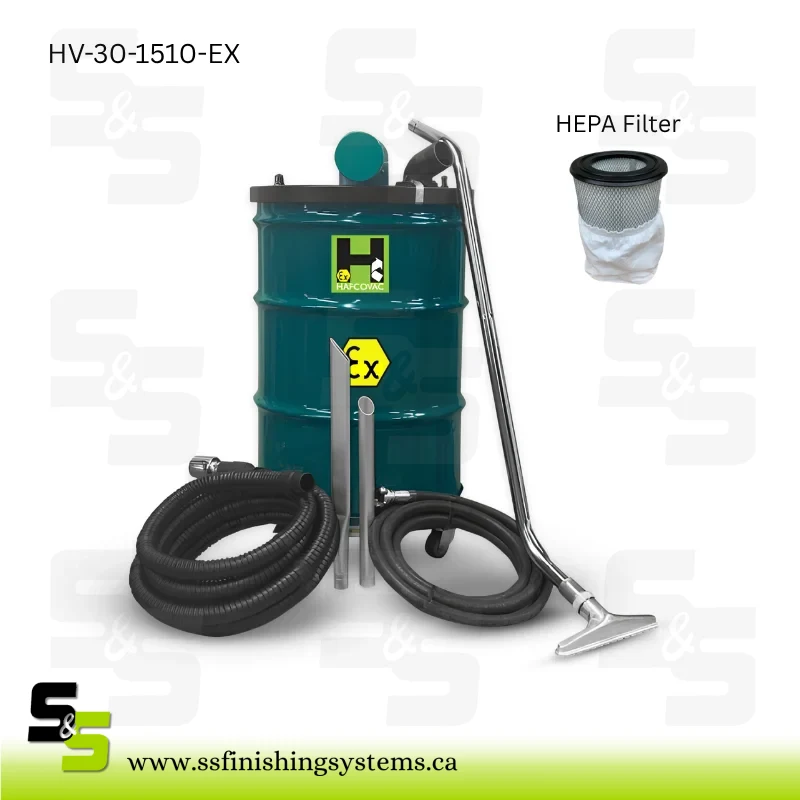 The Economical One
HafcoVac EX
The core certified vacuum. A good fit when you need compliant dust pickup at the lowest cost.
View EX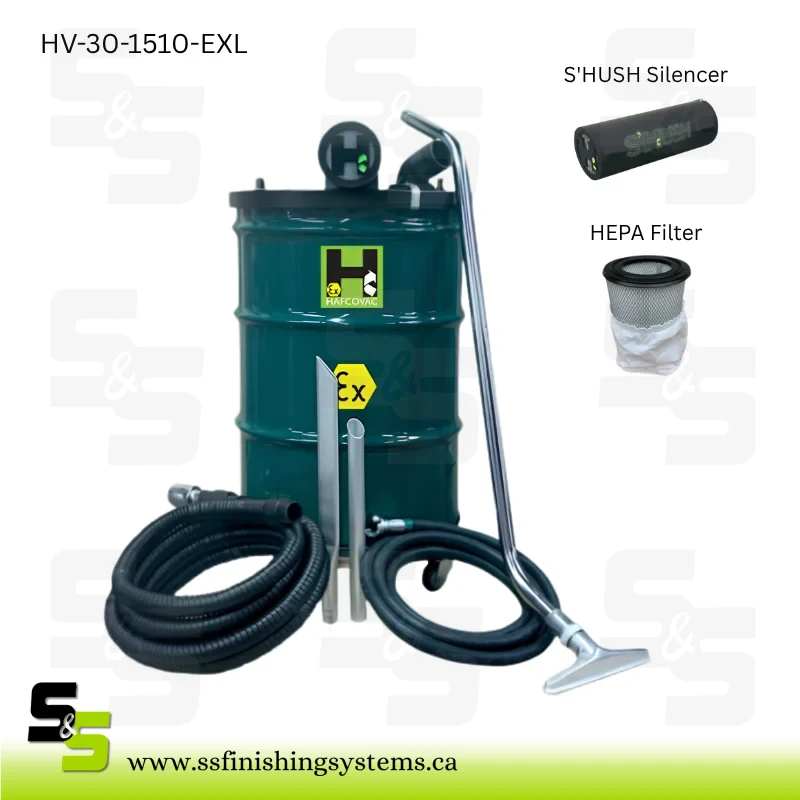 The Quiet One
HafcoVac EXL
Adds the S’HUSH Silencer, which brings noise down to about 77 dB. Ideal where people work close by.
View EXL Easy Storage
HafcoVac EXR
Adds the JACK Tool Holder so hoses and attachments stay on the vacuum as it moves around the plant.
View EXR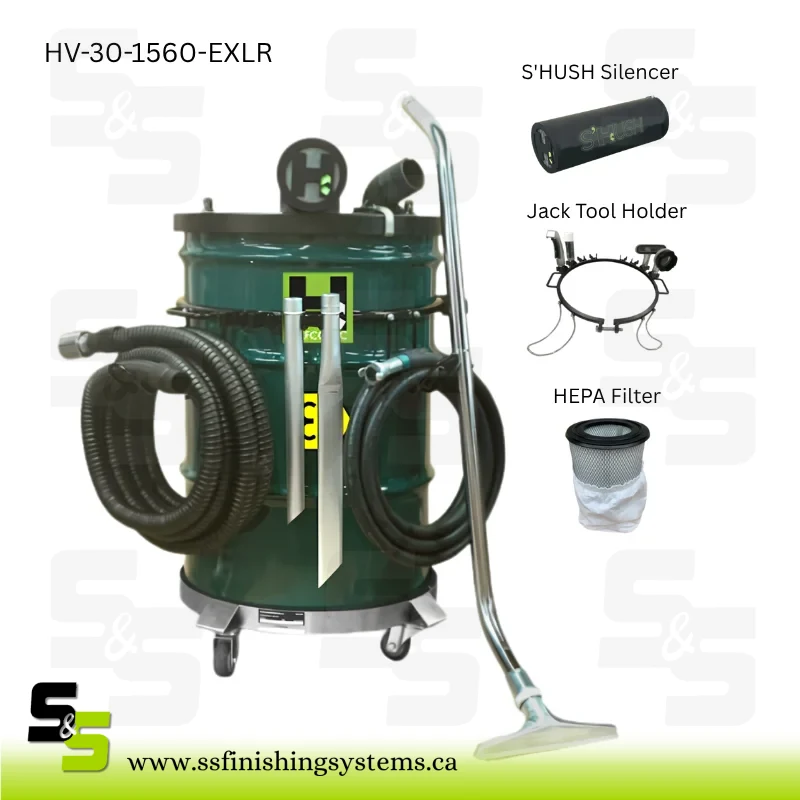 This One Has It All
HafcoVac EXLR
Includes both the S’HUSH Silencer and the JACK Tool Holder. The all-round choice for daily housekeeping.
View EXLR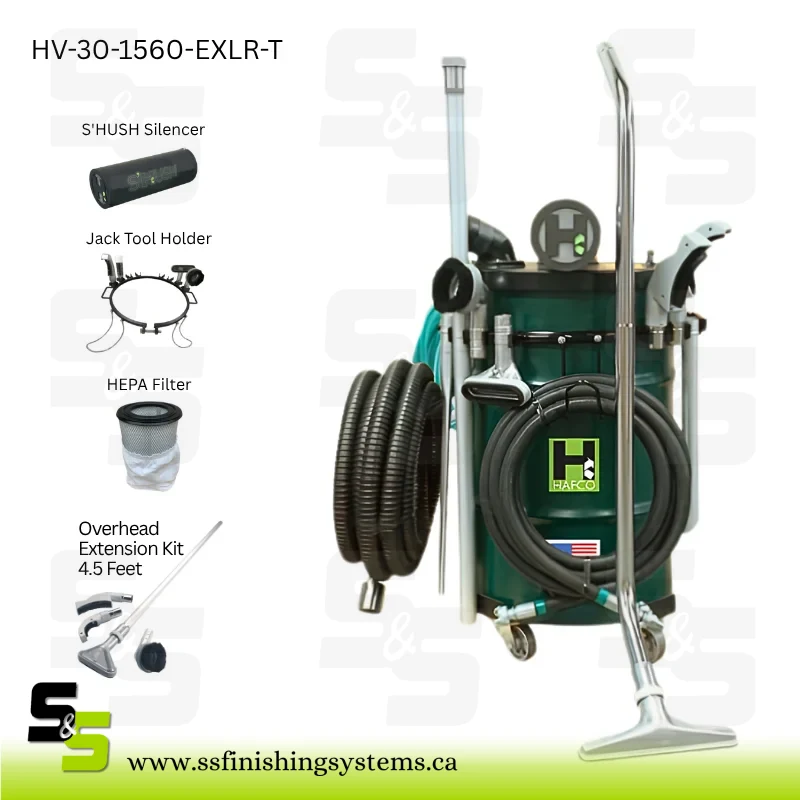 Overhead Cleaning
HafcoVac EXLR-T, T2, T3, T4
The EXLR with a 4.5, 9, 13.5 or 18 ft Overhead Extension Kit for beams, ducts and pipes, where hidden dust builds up.
View EXLR-T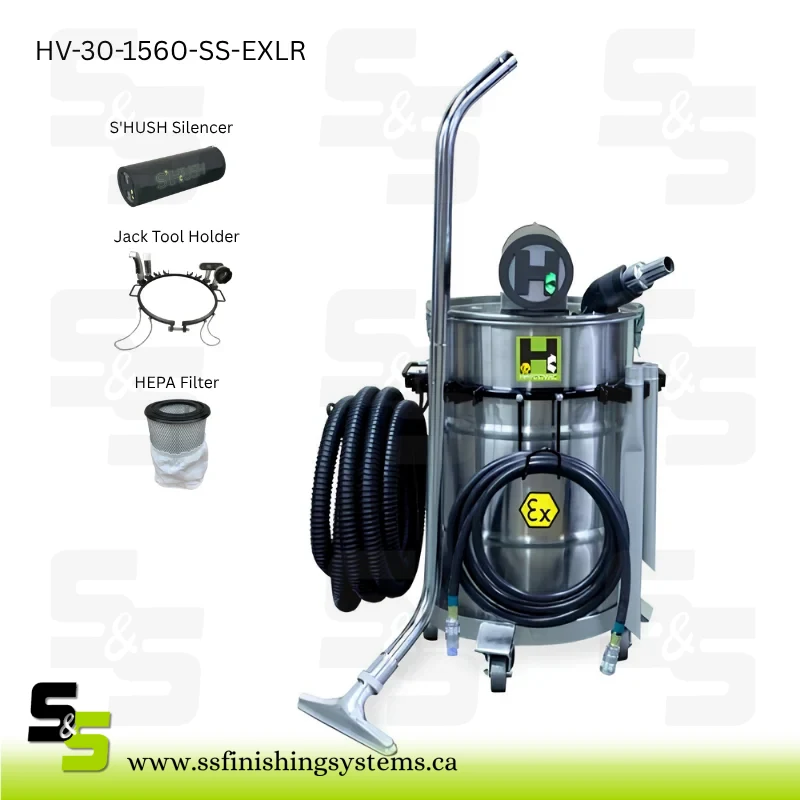 Stainless Steel
 EXLR & Dual EXLR
A stainless drum that resists water, acids, alkaline solutions and chlorine. The Dual model uses a 185 CFM dual venturi head for heavy debris, sludge and hose runs up to 100 ft.
View StainlessAlready have a drum? A HafcoVac Vacuum Head turns a steel drum into a compressed air vacuum, with standard and anti-static versions.
Keep It Working: Simple Maintenance
With no motor to burn out, HafcoVac vacuums carry a lifetime warranty. Only consumables need replacing:
- Main filter: check and replace on a schedule. See the HEPA Filter with Synthetic Bag and the HEPA Premium Filter Bundle.
- Drum liners: an anti-static poly drum liner makes emptying faster and cleaner.
- Silencer foam and gaskets: replace when worn to keep suction and noise where they should be.
- Upgrades: add a S’HUSH Silencer or JACK Tool Holder to an existing HafcoVac.
Each HafcoVac product page includes the operating manual, brochure and how-to videos for filter changes, silencer installation, JACK setup and drum liners.
Frequently Asked Questions
What is an explosion-proof vacuum?
It is an industrial vacuum built and certified so it will not ignite flammable gases or combustible dust in a hazardous location. Compressed air models like HafcoVac do this by using a venturi instead of an electric motor, along with grounded, static-conductive parts.
Can I use a regular shop vac to clean up combustible dust?
It is not recommended. CCOHS advises using wet methods or vacuums approved for dust collection, and OSHA has stated that a vacuum used in a classified dust area must be approved for that classification. A standard shop vac’s motor and plastic hose can create sparks or static.
Why is a compressed air vacuum safer than an electric one?
It has no motor, brushes or moving parts, so there is no electrical arcing and no motor heat. Combined with grounding and conductive hoses, that removes the most common ignition sources.
What size compressor do I need for a HafcoVac?
48 CFM models need at least 10 HP, 85 CFM models need at least 20 HP, and 185 CFM dual venturi models need at least 40 HP, all at 90 PSI. If you are not sure, choose the next size down.
Can a HafcoVac pick up liquids?
Yes. HafcoVac vacuums work wet or dry. For liquids, remove the filter and use the liquid shut-off.
What certifications do HafcoVac vacuums have?
HafcoVac certified vacuums are ATEX certified, NRTL listed and rated for Class I, Division 1 and Class II, Division 1 (Groups E, F, G) hazardous locations. HafcoVac states they meet NFPA 652, 654 and 484 requirements. Confirm with your safety officer that the rating suits your specific location.
Where can I buy HafcoVac vacuums in Canada?
S&S Finishing Systems carries HafcoVac certified vacuums, vacuum heads, filters and parts. Because of their size, vacuums ship with a separate freight quote. Contact us for help choosing a model.
Need Help Choosing a Combustible Dust Vacuum?
Tell us what dust you are collecting, your compressor size and where the vacuum will be used. Our team will help you match the right HafcoVac model, hose and filters. Serving Canadian finishers since 1977.